Range Repair
Viking Stove Basics: Which Series You Own and How It Fails
A Viking stove is a professional-style range made by Viking: powerful burners set over a large oven, sold as gas, dual fuel, electric or induction. Here is how to tell which one you own and why its design causes the faults owners notice.
Written by
Keiko Mabuchi
Service technician — cooktops and ventilation · 11 years in the trade
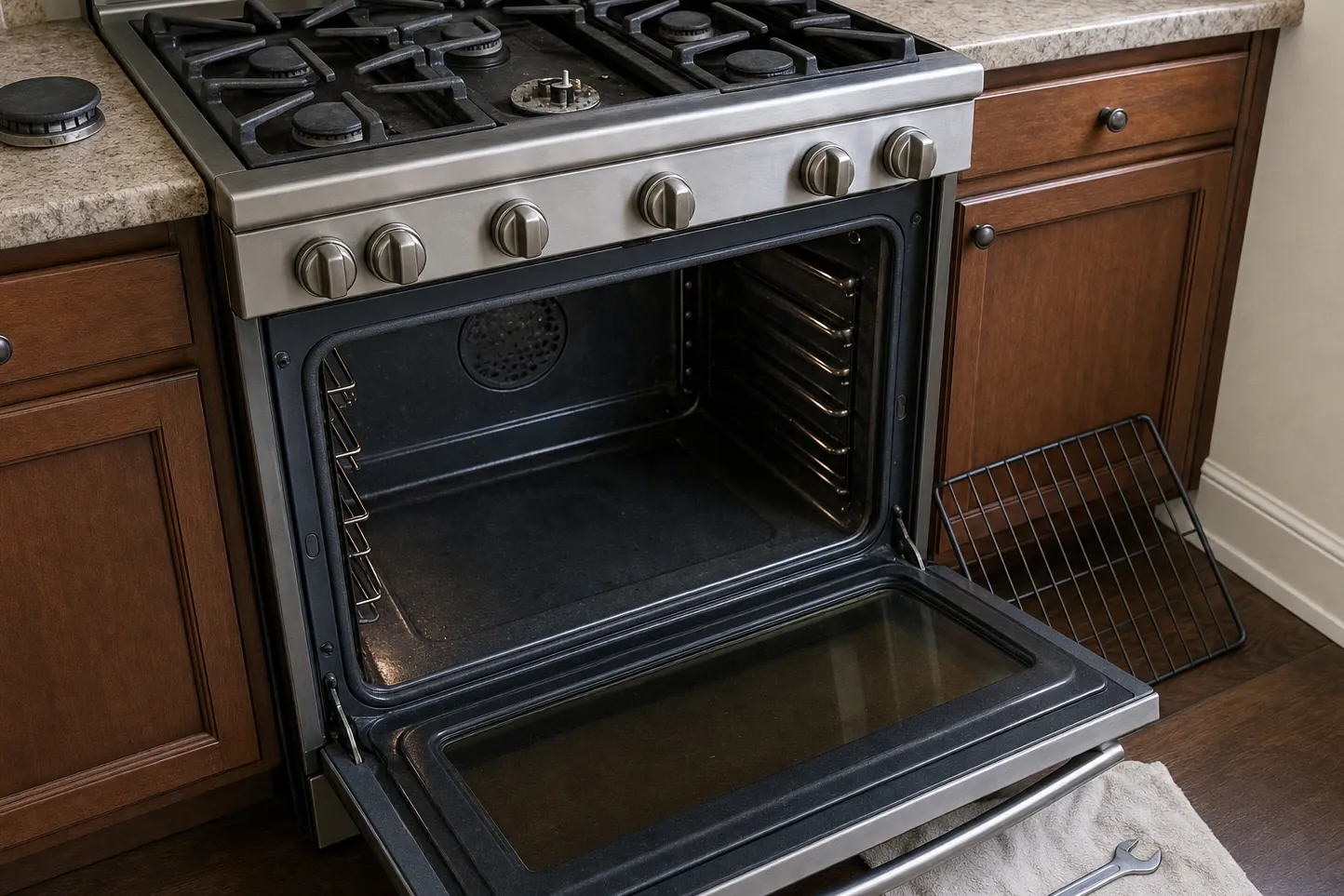
A Viking stove is a professional-style range: a cooktop of strong burners set above a roomy oven, built to look and cook like restaurant equipment, and sold as all-gas, dual fuel, electric or induction. On a typical 5 Series gas model each sealed burner is rated 15,000 BTU on natural gas, and the oven runs on a single 30,000 BTU bake burner. Most of the trouble owners run into, from endless ticking to an oven that refuses to light, comes back to how the gas supply, the spark system and the oven burners are arranged, so it pays to know which Viking is in your kitchen before anyone takes a panel off.
The families sold under the Viking name
Viking groups its freestanding ranges into lines, and the line decides what a technician checks first. The 5 Series is the broadest, from 30 to 60 inches wide, and its prefix tells you the fuel and burner style: VGR is sealed-burner gas, VGIC is open-burner gas, VDR is dual fuel, VER is electric and VIR is induction. The 7 Series comes only in 36- and 48-inch widths, as gas (VGR7362, VGR7482) or dual fuel (VDR7362, VDR7482). The 3 Series is a 30-inch range sold as RVGR3302, RVDR3302, RVER3301 and RVIR330. Tuscany is the dual fuel line, with models TVDR361, TVDR481 and TVDR661.
| Line | Widths and fuels | Cooktop burner output |
|---|---|---|
| 3 Series | 30 inches; gas, dual fuel, electric, induction | 18,000 and 17,000 BTU up front, 12,000 at rear right, two at 9,100 |
| 5 Series | 30 to 60 inches; five fuel and burner types | 15,000 BTU sealed burners; on select models a TruPower Plus front-right burner at 18,500 |
| 7 Series | 36 or 48 inches; gas or dual fuel | 23,000 BTU Elevation Burners across the front, several at 15,000 and one at 8,000 behind |
| Tuscany | dual fuel | three burner sizes spanning 8,500 to 20,500 BTU |
The 3 Series and 5 Series numbers are natural gas ratings; on propane the 5 Series sealed burners fall to 12,500 BTU and the TruPower Plus burner to 16,600 BTU.
Reading the rating plate first
The model and serial number live on a rating plate, and having them in hand means the right part arrives on the first trip. A 5 Series gas range hides it in one of three places: on the left side panel, tucked under the support for the left-front grate or burner bowl; on the oven’s face frame, a little lower than the controls; or behind the control panel just over the oven door. A 7 Series keeps its label beneath the controls, visible once you swing the oven door open. A Tuscany puts its plate on an inner wall, which you reach by removing the storage drawer.
The long model string decodes neatly. After the base model come two letters for the color and, on some ranges, a code for the gas type, so Viking’s sample VGIC53024BWHLP means a VGIC53024B in white, built for propane. The serial dates the range as well: read its opening six digits as month, day and year, and 082421C10019872 comes out as August 24, 2021. Our plain-English list of Viking range parts explains the names you will meet once a panel is off.
How the cooktop lights and keeps burning
Gas reaches the range through a shutoff valve behind it, then passes a pressure regulator fitted at the factory. On a 5 Series that regulator is set for 5.0 inches of water column on natural gas or 10.0 on propane, accepts no more than 1/2 PSI (14.0 inches) at its inlet, and must never be bypassed. From there gas fills a manifold, and each knob opens its own burner valve.
Turning a knob also closes a small switch that wakes the spark module, and the electrodes begin to tick. The system is designed to keep a flame alive: on 5 Series burners, if the flame dies while gas is still flowing, it sparks again and relights without help. A damp electrode after a wipe-down, a cap resting slightly askew or ports clogged with boiled-over pasta water can leave the range ticking on and on, or sparking with no flame. If you hear nothing when a knob turns, Viking suggests turning it back off, making sure the cord is in the outlet, and looking at the electrical panel for a breaker that has tripped or a fuse that has gone. If sparks keep coming but no flame appears, this site’s guide to reading a Viking burner’s tick takes the diagnosis further.
One cause is particular to this region. Many homes around Los Angeles have a seismic shutoff valve on the gas line, and a sharp jolt can close it. Every burner then sparks and nothing ignites, so read what to check when a jolt cuts the gas before deciding the range itself has failed.
How the oven heats
A 5 Series gas oven has one 30,000 BTU bake burner bent into a U below the oven floor and a Gourmet-Glo infrared broiler at the top. Both are lit by SureSpark ignition, and the cavity offers six rack positions. Dual fuel, electric and induction ranges trade the gas oven for an electric one, and Viking’s electric ovens use its Vari-Speed Dual Flow convection system.
Viking points its gas ovens at broiling and single-rack baking, and its electric convection ovens at several racks at once, so cookies that brown unevenly across three racks in a gas oven may be the design rather than a defect. A gas oven that is slow to light, lights and then goes out, or runs well above the dial is another matter, pointing to ignition, the gas valve or temperature sensing. Our guide on a Viking oven running hot deals with the last of those.
Where the design wears
The weak points follow from that layout:
- Spark electrodes and their leads sit right in the spill zone.
- Burner caps and ports must sit flat and breathe freely for the flame to settle and the sparking to stop.
- Knob switches live just above the burners, where cooking vapor gathers year after year.
- Oven ignition and the bake burner work hardest during long roasts and self-clean runs.
As a guide to cost, an igniter or burner assembly typically runs $170–$480, an oven thermostat or heating element $210–$480, and a control board or touch panel $480–$610. Those are typical ranges only; you get a firm price once the fault is diagnosed. The visit itself is a flat $89 covering the drive and the full examination, and that charge comes off the bill as soon as you approve the repair.
What to check before you call
Before picking up the phone, confirm the plug, the breaker and, for a ticking range, that the caps are dry and resting flat. Try another gas appliance in the house to rule out a supply problem, and copy the model and serial number from the rating plate. Then call Viking Pro Appliance Repair Los Angeles at (213) 516-4020. We work on Viking ranges, ovens, refrigerators and dishwashers in Encino, Cheviot Hills, Mar Vista and Larchmont Village.
Loose ends
Does a gas Viking stove need electricity to work?
Yes, a gas Viking range still needs a live outlet, because the spark igniters, the oven controls and the lights all run on household current. With no power, the knobs turn and gas can flow, yet nothing sparks, so a dead outlet looks like a broken range.
Can a Viking gas range run on propane instead of natural gas?
Each range leaves the factory set for one fuel, and the gas-type code at the end of the model number shows which. Changing over means resetting the regulator and swapping burner orifices, so it is work for a qualified gas technician rather than a weekend project.
Why does my Viking oven smoke during self-clean?
Some smoke and smell is normal, since the cycle heats the cavity to as much as 750°F to burn residue down to ash. Scrape out heavy grease beforehand, run the hood, and plan on the oven being out of use for 3 to 3½ hours plus a 30-minute cool-down.